
What Actually Works for Dyslexia: Structured Literacy (Without the Confusion)

Updated: Apr 7
If you have more than one child, you may have experienced something that feels confusing at first.
You used the same reading approach, the same books, and the same routines, and it worked. Your other child seemed to pick up reading without much difficulty. They learned it along the way, and it did not require a lot of extra explanation.
But then you had a child who struggled.
You tried the same things that worked before. You followed the same advice and stayed consistent, but this time it did not work in the same way. Progress was slower, less predictable, and often frustrating for both you and your child.
That experience can leave parents questioning everything. You may find yourself wondering if you missed something or if you should be doing more. It can be hard to understand why something that worked before suddenly does not.
The reality is that children do not all learn to read in the same way. Some are able to pick up reading more implicitly. They begin to notice patterns and make connections with less direct instruction.
But not all children learn that way.
Struggling readers, especially those with dyslexia, often need reading to be taught more clearly and more directly. When instruction relies too much on children figuring things out on their own, important gaps can form.
So it leads to a natural question:
If those approaches worked before but are not working now, what actually does?
The answer is an approach called Structured Literacy.
Key Takeaways
Struggling readers often need different instruction, not more effort
The science of reading explains how reading develops and why some children struggle
Structured Literacy is the instructional approach based on that research
It teaches reading clearly, directly, and step by step
The quality of instruction matters more than the program itself

Why Some Reading Instruction Does Not Work
This can be both frustrating and relieving for parents to realize.
When reading is not developing as expected, it is not always about effort. It is often about how reading is being taught.
Many widely used reading programs are designed for students who learn to read more easily. They assume that children will naturally pick up patterns, make connections, and fill in gaps along the way.
But for students who struggle, especially those with dyslexia, that assumption does not hold.
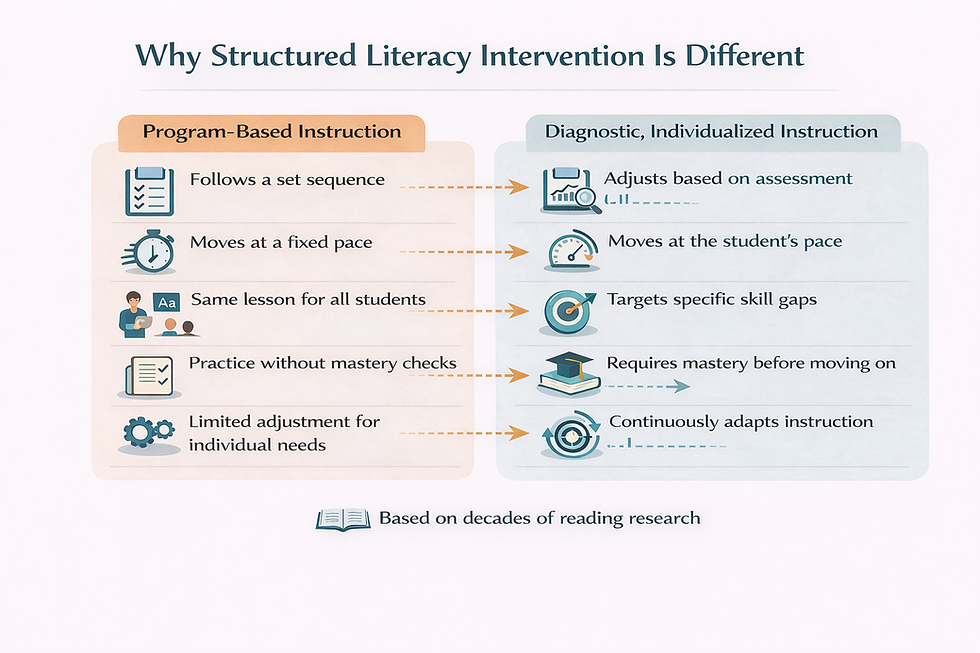
Instruction may include phonics, but it is often not taught in a way that is systematic, cumulative, and connected. Skills may be introduced quickly, with limited review, and students may be expected to apply strategies before they fully understand how the language works.
In some cases, students are encouraged to rely on context, pictures, or partial information to figure out words. This can create the appearance of reading, but it does not build a strong foundation.
When the structure of the language is not made clear, students are left to compensate instead of truly learning to read.
For many struggling readers, this leads to confusion, inconsistency, and slow progress over time.
The Term You Have Probably Heard: Structured Literacy
At some point, you may have heard: “Your child needs Structured Literacy.”
But what does that actually mean?
It is a fair question, and one that is often not clearly explained.
The reason this term comes up so often is because it is directly connected to something called the science of reading. The science of reading explains how children learn to read, why some children struggle, and what kind of instruction is most effective.
Structured Literacy is the way that research is put into practice.
So before we define Structured Literacy, it helps to briefly understand the research behind it.
What Is the Science of Reading?
Reading researcher Reid Lyon explains:
The science of reading is a body of evidence that explains how students learn to read, why some have difficulty, and what educators need to do to teach reading effectively.
In simple terms:
The science of reading is the research. Structured Literacy is how that research is used in teaching.
What Is Structured Literacy?
Structured Literacy is what happens when research about reading is used to guide instruction. It is not a single program or curriculum. It is a way of teaching.
At its core, Structured Literacy means that the full structure of language is taught clearly, directly, and in a planned sequence.
To really understand it, it helps to look at three parts: who it is for, what is taught, and how it is taught.

Who It Is For?
Structured Literacy is essential for students who struggle to learn to read, including students with dyslexia.
These are students who do not naturally pick up reading patterns on their own. They need instruction that is more explicit, more structured, and more responsive.
At the same time, this approach benefits all students.
It works for everyone, but it is critical for those who need reading to be made clear.
What Is Taught?
Structured Literacy goes far beyond phonics.
It teaches how the entire language system works, including both word recognition and understanding.
On the word level, students learn:
how sounds connect to letters (phoneme-grapheme relationships)
how words are built from meaningful parts (morphemes like prefixes and suffixes)
how syllables and stress patterns organize longer words
how spelling patterns and conventions work
But it does not stop there.
Students also learn how language supports meaning, including:
vocabulary and background knowledge
sentence structure and grammar
how different types of texts are organized
how to think about and understand what they read
Reading and writing are taught together, because they reinforce each other.
Instead of focusing on isolated skills, Structured Literacy helps students see how all parts of language fit together.
How It Is Taught
Just as important as what is taught is how it is taught.
In Structured Literacy, instruction is:
Explicit – the teacher clearly explains and models each skill
Systematic and sequential – skills are taught in a planned order, from simple to complex
Cumulative – new learning builds on what has already been taught
Instruction is also:
Diagnostic and data-driven – teaching is adjusted based on how your child is responding
Mastery-oriented – students are given enough time and practice to truly learn a skill
In addition, learning is supported in several important ways:
Students are actively involved, not just listening
Learning is multimodal – students see it, say it, hear it, and write it
Instruction is scaffolded – support is provided and gradually reduced
Feedback is immediate and specific, so mistakes do not become habits
Practice is sufficient and targeted, so skills become more automatic
Lessons are intentionally designed to connect reading, writing, and oral language, rather than teaching them separately.
This is what makes learning stick and transfer over time.

What This Looks Like for Your Child
When instruction is truly structured, it feels different.
Your child is not guessing or trying to figure things out on their own.
Instead, they are shown exactly what to do, guided step by step, and supported until the skill becomes more automatic. Each lesson builds on the last, and all parts of language are connected.
Why This Matters
This is why a reading approach can work well for one child and not for another.
Some children are able to pick up reading patterns with less direct instruction. They begin to recognize words and make connections without needing everything to be clearly explained.
But many children do not learn that way.
They need reading to be taught in a way that is more direct, more structured, and more connected.
Structured Literacy is designed for the child who needs reading to be clearly explained, not left to chance.
What This Looks Like in Real Instruction
Instead of focusing on one word or one skill at a time, Structured Literacy lessons are designed to help students understand how the language system works as a whole.
A lesson might begin with a review of previously learned patterns so that skills stay strong over time. The teacher then introduces a new concept, clearly explaining and modeling how it works.
Students read words that follow that pattern, but they do not stop there.
They may also:
spell those same words
read them in sentences and short passages
notice how word parts like prefixes or suffixes affect meaning
discuss vocabulary and how words are used in context
As students grow, instruction expands to include more complex language.
They learn how sentences are structured, how ideas are organized in a paragraph or passage, and how to read with understanding. Writing is also part of the process. Students write words, sentences, and eventually longer responses, applying the same patterns they are learning to read.
They may edit their own writing using a guide, correct errors, and think about how to make their ideas clearer.
Throughout the lesson, the teacher is paying close attention to how the student is responding. If something is not sticking, the instruction is adjusted and retaught with more support.
Over time, these pieces begin to connect.
The student is not just learning to read individual words. They are learning how sounds, spelling, word structure, and meaning all work together.
This is what makes Structured Literacy different. It is not a single strategy or skill. It is a connected system of instruction that builds understanding over time.
What Good Instruction Looks Like
When instruction is aligned with this approach, it has a clear and consistent feel. Lessons are explained, sequenced, and practiced in a way that builds over time, with students actively involved and supported until skills become more automatic.
Why This Approach Works
Reading is not a natural process like speaking. While some children pick up parts of it more easily, many do not.
Reid Lyon explains that students must learn how written language represents speech, how to read and spell words accurately, and how to use language for meaning.
Structured Literacy is designed to build all of these areas in a connected way. It focuses first on accuracy, then builds toward fluency and comprehension.
When instruction matches how the brain learns to read, progress becomes possible
One Important Truth for Parents
There is one thing every parent should understand.
The quality of the teaching matters more than the program itself.
Structured Literacy is not a brand name. It is a way of teaching.
What matters most is whether instruction is clear, structured, and responsive to your child.
Final Thought
If your child is struggling to learn to read, it does not mean they are not trying hard enough.
More often, it means they have not yet been taught in a way that matches how they learn.
Some children can pick up reading with less direct instruction. Others need reading to be taught clearly, systematically, and with enough support for skills to truly take hold.
When instruction is aligned with how reading develops, progress becomes possible.
And for many students, that is the turning point.
Need Help Figuring Out Next Steps
If you are beginning to recognize that your child may need more structured, explicit instruction, the next step is not to try harder, but to look more closely at the type of instruction they are receiving.
Programs that follow a Structured Literacy approach are designed specifically for students who need reading to be taught in a clear, connected, and supported way.
One example of this is the Wilson Reading System, a Tier 3 intervention created for students with dyslexia and other language-based reading difficulties. It is research-based, systematic, and designed to build reading and spelling skills step by step over time.
This is the type of instruction I provide in my tutoring practice as a Reading Specialist and Wilson Dyslexia Practitioner. There is a clear path forward, and I can help you take that next step with a free 30-minute consultation.
About the Author

Hi, I’m Heidi. I am a licensed Reading Specialist and a Wilson Dyslexia Practitioner with over 20 years of experience in education. Since 2022, I have been supporting children with dyslexia and spelling challenges both online and in person through private practice, working with students in grades 2–12 in the United States and with international school students around the world.
My goal is to make this journey less overwhelming and more empowering for families, helping children gain confidence and success in reading and spelling.
Connect with Heidi at Successfuldyslexiatutoring.com or on Linked in.
References
International Dyslexia Association. (2014). Structured literacy: Effective instruction for students with dyslexia and related reading difficulties. https://dyslexiaida.org/structured-literacy-effective-instruction-for-students-with-dyslexia-and-related-reading-difficulties/
International Dyslexia Association. (2023). Structured literacy education infographic. https://dyslexialibrary.org/structured-literacy-education-infographic/
International Dyslexia Association. (2023). Perspectives on language and literacy: 75th anniversary edition. https://dyslexialibrary.org/perspectives-75th-anniversary-edition/
International Dyslexia Association. (n.d.). From adversaries to allies: Bridging research and practice [Video]. IDA TV. https://dyslexiaida.org/exciting-new-release-on-ida-tv-free-educational-video/
Lyon, G. R. (2020). The science of reading and dyslexia: From research to practice. International Dyslexia Association.
Moats, L. C. (2020). Speech to print: Language essentials for teachers (3rd ed.). Paul H. Brookes Publishing.
National Institute of Child Health and Human Development. (2000). Report of the National Reading Panel: Teaching children to read. U.S. Government Printing Office.
Institute of Education Sciences. (2016). Foundational skills to support reading for understanding in kindergarten through 3rd grade (NCEE 2016-4008). U.S. Department of Education. https://ies.ed.gov/ncee/wwc/PracticeGuide/21
Wilson Language Training. (2022). Wilson Reading System®. https://www.wilsonlanguage.com/programs/wilson-reading-system/
Wilson Language Training. (n.d.). Wilson professional learning and credentials. https://www.wilsonlanguage.com/professional-learning/wilson-professional-credentials/#free-and-low-cost
Snow, C. E., Burns, M. S., & Griffin, P. (1998). Preventing reading difficulties in young children. National Academy Press.

